Showing posts with label agriculture. Show all posts

Monday, August 20, 2018

E-CARE hosts international development training

Twenty-two Anglicans from Myanmar and Mexico journeyed to the Diocese of Santiago for E-CARE’s annual International Development Training, eager to learn how to develop the economic wellbeing of their communities. They came to see how the Episcopal Church in the Philippines established self-reliance as a Church, in pursuit of financial independence themselves. The Diocese of Santiago serves as a shining example of how cooperatives can both empower communities with access to capital and generate income for the church.
Priest and lay members of Christ Episcopal Church share challenges and lessons in forming their savings group.


For one week, trainees, a couple E-CARE community organizers and I immersed ourselves in the St. Williams Multipurpose Cooperative in Paracelis, Mountain Province, surrounded by beautiful lush forest landscape (with no internet or cell service!). We learned firsthand of St. Williams path from a new mission station surrounded only by trees and a few farms in the 1990s to becoming a thriving parish and a catalyst for significant development in the barangay (village).
Inside the main office of St. Williams' savings & lending operations


St. Williams Multi-Purpose Cooperative began as a savings group among 3 of the Episcopal Church women with a capital of about $20. At this time, cash flow was heavily restricted. If a family needed to money for school tuition or if a family member were to fall ill, one would need to walk to the center of town (a half day trek through the mountains) and try to borrow from a wealthy businessman, with no certainty that one might be willing to lend.

They began small, with membership limited to only church women, then all church members, then Anglicans; now, any person who wants to join in the spirit of cooperation is welcome. Over the last 25 years, it has grown to have 1800+ members, 50+ employees, and a capital assets valuation greater than half the municipalities in the Philippines!
Trainees and staff in front of SWMPC main office building


By providing access to capital, St. Williams has promoted the development of the local community -- and their membership is expanding beyond the Cordillera region to all parts of Luzon! They’ve also expanded their services savings and lending, now offering rice and corn processing, rice and corn trading, transport, farm input supply, four general merchandise stores, a pharmacy, an elementary school, a teaching farm and more!
Inspecting milled corn at SWMPC rice and corn processing center
Touring the SWMPC teaching farm

Trainees (and myself!) learned the basics of starting a cooperative from the St. Williams’ staff’s presentations, tours of their facilities and stories of their challenges. Traveling back to Santiago and onto Manila with the trainees, I was encouraged hearing their excitement to apply these lessons in their own communities. Myanmar in particular, in the process of transitioning to democracy from a military regime, has vast potential for growth as community organizing is a relatively new opportunity. We’ll watch and see how these 2 countries (and their Anglican churches) empower people to enhance their livelihoods, support their church and, in turn, assert themselves in true independence.


Trainees participate in a workshop creating a coop plan to generate income for their parish
International fellowship!

Monday, June 18, 2018

Organizing for Development: Vegetable Growers of St. Cyril Parish, Quirino

A Wednesday afternoon in Quirino Province, in a church nestled in the foothills of the Cordillera mountains, twenty or so women gather in St. Cyril Episcopal Church to discuss the policies and procedures for their newly formed cooperative organization. Most of the members sustain their livelihoods through vegetable farming, making barely enough to cover household expenses.
E-CARE community organizers walk in to join the meeting. The agenda for the day is to finalize the organization’s policies and procedures for member lending. E-CARE must oversee the process to ensure guidelines are in place so community.

The discussion begins with Jane, this community’s E-CARE project officer, making recommendations for the group and sharing policies of the Receivers 2 Givers program (through which community groups avail of funds which they then grant onto other communities in the program). The organization’s leaders, too, share their ideas, and members evaluate what will be best for their purposes.
The main point of discussion was the amount of share capital members should contribute before being able to borrow from the organization’s funds. Some were unhappy the set amount of individual share capital was so high (10% of the total amount they seek to borrow) because it prohibited them from borrowing a higher amount. However, this policy is necessary to ensure members don’t borrow more than they are able to repay and go into debt. E-CARE must ensure members are borrowing responsibly, so we oversee the fledgling organization’s policy development.

After the meeting, community members share their stories. This woman, like most in the organization, is a vegetable farmer. She appreciates how the AWD trainings
have equipped her with household budgeting skills. She avails of R2G funds and is thankful that the add-on is lower than interest rates of available lending options, so her family can increase their household income to send their children to school.
Another woman also avails of R2G funds to support her vegetable farming livelihood. She has struggled to make payments on time but is working hard to grantback and using skills gained through trainings.

All members share a similar experience: enhancing financial literacy through trainings, increasing their household income through the R2G program. Furthermore, as a whole, the community is enhancing their social capital -- forming bonds of trust and developing their ability to work together.
(Stay tuned -- videos coming soon!)

Wednesday, April 18, 2018

Why farm sustainably?

Last August before returning to the US, three of us from the E-CARE office in Santiago traveled to San Mateo, Isabela to attend the Phillipine Rice Research Institute’s (PhilRice) Farmer Training School, and to present on how rice cultivation contributes to climate change.


The week prior, we had dropped by PhilRice’s local office to share with them our project idea and talk about alternate wetting and drying (AWD), a sustainable irrigation technique. They were supportive of our initiative and praised AWD for its water-savings benefits and invited us to present on the reciprocal relationship between rice farming and climate change.
Controlled Irrigation: Promotes the right timing of field irrigation, lessens water usage, reduces methane emissions


So we arrived yesterday morning to the open warehouse-type space at PhilRice’s demo farm where 30 farmers were gathered to learn the best practices on land preparation, fertilizer management and greenhouse gas mitigation. During our presentation, I shared with the farmers a brief overview of the mechanics of climate change, the methane cycles in dry vs. flooded fields, and the UN’s approved methodology for calculating emission reductions.


But why is sustainable rice farming so important?


For one, rice is a daily staple for 3.5 billion people (19% of global dietary energy) and a livelihood for 1 billion. As the world’s population increases, so must rice production to meet food security needs. But not without an impact on climate change. Looking back in the past 50 years, GHG emissions from agriculture have doubled.


Rice farming accounts for 10% of the world’s emissions from methane, which is 25x more potent than CO2 in trapping heat in the atmosphere. In Philippines alone, rice farming accounts for 13% of GHG emissions, and all agriculture is responsible for 30% of emissions here. Thankfully the country is working towards meeting its commitment to reduce emissions by 70% by 2030.


AWD is a part of that effort. One hectare of flooded rice fields emits more than 30 tonnes CO2e per year. But by using AWD, field emissions are reduced by nearly 50%.


GHG mitigation isn’t the only benefit, but water conservation is significant as well. While rice occupies 30% of the world’s agricultural land, it uses 40% of irrigation. So using AWD to conserve water by 30% can make water available for household use, industry or more agriculture.
Sharing the same presentation mentioned above to a farmer group at St. Mark's Episcopal Church in Batal, Santiago, Isabela.

Thursday, August 10, 2017

Rice for the World

Last post, we learned about rice cultivation's environmental impact. But there is hope for a solution! Alternate Wetting and Drying (AWD) -- it’s an irrigation technique which reduces methane emissions by 50% and water usage by 30%.

In traditional rice cultivation, the fields remain continuously flooded during growing season. The organic matter in the soil (straw, manure, etc) decomposes anaerobically (without air) and releases as a byproduct, methane, a greenhouse gas 25x more potent in greenhouse warming effect than carbon dioxide (CO2).


Transplanting rice in a flooded field -- hard work!

In AWD, the water level is allowed to drop to 6 inches below the top of the soil before irrigating again to 2 inches above soil level. This process of drying the soil and irrigating continues until harvest. Since the soil is allowed to dry periodically, the organic matter decomposes with the help of oxygen, preventing methane from being produced.

This practice has proven to have no negative impact on yield; in fact, in some cases, yields increased. Farmers have also reported that the roots have better anchorage (making them typhoon-resistant). Grains also have a good shape and size, with lower trace amounts of arsenic that naturally occurs in rice.

Moreover, AWD practice reduces methane emissions by 50% on average and decreases water use by 30%. It’s a win-win situation for climate change mitigation and adaptation. Not only are farmers reducing their greenhouse gas emissions, but they are also adopting a climate-smart technique which will better prepare them for water scarcity which climate change may bring.

With decreased water usage, farmers save money in cases where they use diesel-pumped irrigation systems. AWD also decreases conflict between farmers since there is less likelihood of experiencing a water shortage.

The main challenge to implementing AWD will be to break farmers’ deeply entrenched belief that rice is an aquatic plant that needs to be continuously flooded. No easy task where almost all the rice fields are cultivated by smallholder farmers with 1.2 hectares each on average and have been growing rice for generations.

However, AWD has been gaining ground. It’s being adopted in China, Vietnam, Myanmar and Indonesia. In the U.S., too! In fact, the world’s first carbon credits from AWD in rice cultivation were generated just last month by farmers in Mississippi, Arkansas and California. 

The 5th Mark of Mission of the Anglican Communion guides us in our calling “to strive to safeguard the integrity of creation and sustain and renew the life of the earth.” We can live into this mission wherever we are and in whatever we do, whether we are farmers or office workers. For farmers, this means cultivating the land in the best way possible. For an office worker, it may mean shutting down computers to save electricity, turning off lights, reducing waste and recycling and composting at work. Everyday, we have the opportunity to show thanks to God for the beauty and resources He gives us by being good stewards of His creation. Let’s show it!

Thursday, July 27, 2017

Climate Change for an Island Nation

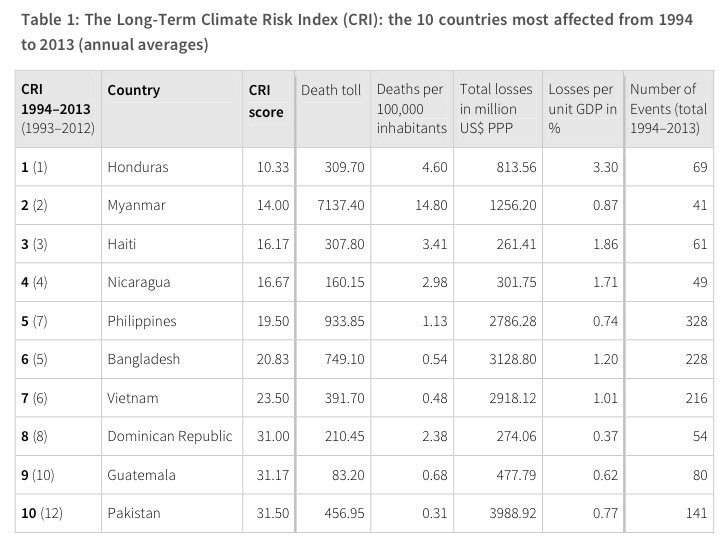
In 2012, Philippines was ranked the most vulnerable country in the world to climate change by a German organization. In 2013, we fell to #5, but take a look at the list here and think: who pollutes, and who pays?


Philippines and other tropical, developing countries are positioned to suffer from from the impacts of climate change in terms of fatalities and economic loss from climate-related disasters. 

For Philippines, climate change is expected to bring rising mean temperatures, change in amount and intensity of rainfall, and a change in the number of tropical cyclones. 

The agricultural industry (which accounts for 11% of GDP) is particularly vulnerable since it relies on traditional knowledge and predictable weather patterns. Twelve million Filipinos, or 30% of the labor force, sustain their livelihood in agriculture. A land-owning farmer has about 1.2 hectares, on average. 

For these smallholder farmers, climate change could bring decreased productivity and increased pests and plant disease, which may affect yields. This would be devastating for a farmer, living in poverty, whose entire livelihood is dependent upon the climate.

Thankfully, Philippines is mobilizing to act on climate. Climate change is no joke to Filipinos; they experience it firsthand. With the Filipino environmental ethic, people conserve resources and take pride in being good stewards of the Earth.

For one, the E-CARE Foundation partners with communities and Episcopal Relief and Development to plant trees to absorb carbon dioxide. 

Stay tuned for the next post to explore what other options for climate change mitigation and adaption Philippines is developing!

Sunday, June 25, 2017

I've moved!

I am now based in Santiago City, Isabela Province!

At the beginning of June, I transferred here to The Episcopal Diocese of Santiago to work on a low-greenhouse gas emission rice farming project. Santiago City, located in the Cagayan Valley, is nestled between the Cordillera Mountains (where I was living) to the West, and the Sierra Madre Mountains to the East. 

A snapshot from the early morning drive from Manila to Santiago:


Although this is a lowland region, many of the E-CARE partner communities are Igorot (from the mountains) who transferred here for greener pastures in the 1970s. The livelihood of most of the E-CARE partner communities here is rice farming. In fact, this region is known second-largest rice-producing area in the Philippines!

The traditional rice cultivation method is to keep the fields continuously flooded throughout the growing period. This creates methane emissions, since the rice straw left on the field doesn't come into contact with the air, so it decomposes anaerobically, emitting methane as a byproduct. 

However, if the fields are allowed to drain enough to dry the top of the soil, methane emissions can be reduced by 50%. This method, known as Alternate Wetting and Drying (AWD), also saves water by about 30%, may increase yields, and promotes food security.

The trick is in outreach to the farmers to break the long-held belief that rice is an aquatic plant. (It is a semi-aquatic plant).

Stay tuned for more updates on the project!